The European Union is preparing a massive retaliatory trade strike against the United States. In response to President Donald Trump’s threats over Greenland, the bloc is readying €93 billion in tariffs. Additionally, it is considering restricting American companies’ access to the EU single market. This EU tariffs retaliation plan marks the most severe crisis in transatlantic relations in decades. The measures aim to provide European leaders with leverage during pivotal talks at the World Economic Forum in Davos. Officials hope to find a compromise and avoid a catastrophic rupture in the Western military alliance, which would threaten Europe’s security.
The tariff list was prepared last year but suspended until February 6. Its reactivation was discussed by EU ambassadors on Sunday. Alongside tariffs, the bloc is debating using the Anti-Coercion Instrument (ACI). This tool can limit market access for U.S. companies, including Big Tech firms. France is pushing for its deployment. This coordinated EU tariffs retaliation strategy represents a “carrot and stick” approach. The goal is to publicly call for calm while demonstrating Europe’s capacity to inflict significant economic pain if Trump proceeds with his own threatened tariffs.
The Escalating Crisis Over Greenland
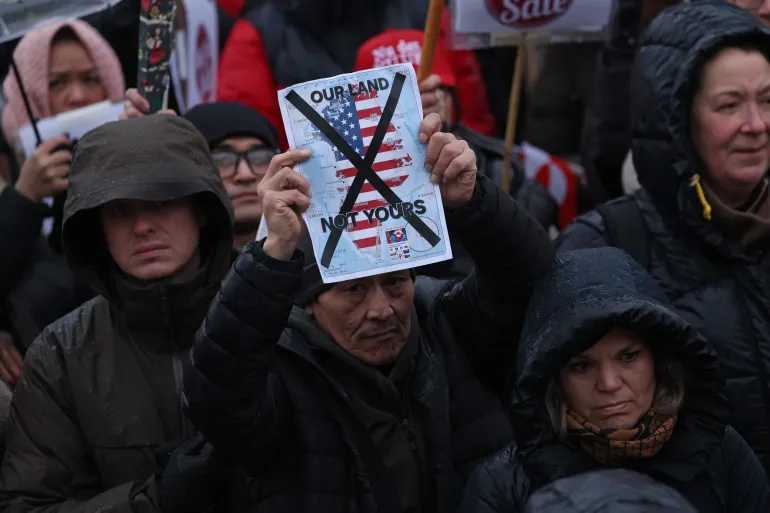
Trump’s threat is direct and punitive. He vows to impose a 10% tariff on eight nations by February 1, rising to 25% by June. The targets are the UK, Norway, Denmark, Sweden, France, Germany, the Netherlands, and Finland. This punishment is for their opposition to his campaign to acquire Greenland and for sending troops to a military exercise there. European leaders uniformly reject the territorial demand. Danish Prime Minister Mette Frederiksen stated, “We want to co-operate, and it is not we who are seeking conflict.” However, the U.S. position remains unyielding.
U.S. Treasury Secretary Scott Bessent reinforced the hardline stance on Sunday. He claimed Europe is too weak to guarantee Greenland’s security. “The president believes enhanced security is not possible without Greenland being part of the US,” he told NBC News. This justification frames the demand as a national security imperative, dismissing both Danish sovereignty and the wishes of Greenland’s Inuit population. The EU’s planned EU tariffs retaliation is a direct response to what one diplomat called “pure mafioso methods.”
Diplomatic Maneuvers at Davos
The World Economic Forum in Davos becomes the critical diplomatic arena. Trump is scheduled to hold private talks with European Commission President Ursula von der Leyen and other leaders. A previously planned meeting of Western national security advisers, initially focused on Ukraine, has been overhauled to address the Greenland crisis. European officials hope their retaliation threats will create bipartisan pressure in the U.S. and provide Trump an “off-ramp” to retreat.
The European Parliament has already taken a preliminary step. The biggest parties delayed a planned vote that would have reduced EU tariffs on some U.S. goods. This signal underscores the seriousness of the moment. The EU’s message, as stated by von der Leyen, is that Europe will “stand firm in our commitment to uphold the sovereignty of Greenland and the Kingdom of Denmark.” The planned EU tariffs retaliation is the concrete action backing that statement.
Potential Use of the Anti-Coercion Instrument
The Anti-Coercion Instrument (ACI) is a powerful new tool, adopted in 2023 but never used. It allows the EU to respond to economic coercion with countermeasures, including investment restrictions and limits on service exports. France is a strong advocate for its use now, calling Trump’s threat “textbook coercion.” While many member states support exploring the ACI, a majority prefer attempting dialogue with Trump first. They seek to “get the temperature down” before activating the bloc’s most aggressive trade weapon.
Deploying the ACI against the U.S. would be a historic escalation. It could throttle the operations of major American technology and financial services firms in Europe. This prospect makes it a potent deterrent. The EU’s preparation of both tariffs and the ACI creates a layered response. It shows Trump the immediate cost (tariffs) and a more severe, structural consequence (market restrictions) if he continues. This EU tariffs retaliation package is designed to demonstrate resolve and capability.
Broader Implications for NATO and Transatlantic Ties
The crisis poses an existential threat to NATO. A trade war between allies, triggered by a territorial dispute, would shatter alliance unity. European Council President António Costa has called an extraordinary EU summit for later this week. He stated the EU is ready “to defend ourselves against any form of coercion.” The situation has fundamentally shifted the transatlantic relationship from partnership to confrontation over a previously unthinkable issue.
European officials acknowledge the gravity. “It is already a situation that no longer allows compromises, because we cannot hand over Greenland,” said one official. They hope “reasonable Americans” will recognize Trump has “opened Pandora’s Box.” The coming days in Davos will determine whether diplomacy can avert a full-scale economic conflict. The EU’s readiness to enact €93 billion in EU tariffs retaliation shows it will not capitulate to coercion, even from its most powerful ally.