The European Union is scrambling to formulate a unified response to a major new trade threat from the United States. President Donald Trump has announced escalating tariffs on several European allies. This Greenland tariff threat is punishment for opposing his push to acquire the semiautonomous Danish territory. Trump stated tariffs on eight nations will start at 10% on February 1 and rise to 25% by June. The duties will remain until a deal for the “Complete and Total purchase of Greenland” is reached. Consequently, the EU has called an emergency meeting for Sunday to coordinate its reaction.
The targeted countries include Denmark, Norway, Sweden, France, Germany, the UK, the Netherlands, and Finland. In a Truth Social post, Trump framed the issue as a national security imperative. He claimed China and Russia desire Greenland and Denmark is powerless to stop them. He also stated the U.S. has sought the island for over 150 years. This Greenland tariff threat marks a severe escalation in a long-standing obsession of the president. It weaponizes trade policy to force a territorial transaction that both Greenland and Denmark have repeatedly and forcefully rejected.
European Leaders Condemn the Threat
Initial responses from European leaders have been firm and dismissive. UK Prime Minister Keir Starmer directly criticized the move on social media. “Our position on Greenland is very clear – it is part of the Kingdom of Denmark and its future is a matter for the Greenlanders and the Danes,” Starmer wrote. He called applying tariffs on allies for collective security “completely wrong.” The UK pledged to pursue the matter directly with the U.S. administration. This unified defense of Danish sovereignty underscores the rift Trump’s policy has created within NATO.
The broader EU response will be critical. The 27-member bloc must decide whether to retaliate with its own tariffs, seek legal challenges at the World Trade Organization, or pursue diplomatic de-escalation. The Greenland tariff threat puts European governments in a difficult position. They must defend a core ally and the principle of territorial integrity while avoiding a full-scale trade war with a key partner. The emergency meeting will test EU cohesion and its strategic patience with the Trump administration’s unconventional pressure tactics.
Background: The Strategic Allure of Greenland
Greenland’s appeal to U.S. strategists is longstanding. Its location offers the shortest routes between North America and Europe. The U.S. maintains the Pituffik Space Base (formerly Thule Air Base) on the island, a critical node for missile warning and space surveillance. As climate change opens the Arctic, competition for resources and shipping lanes intensifies. Greenland possesses vast deposits of rare earth minerals and other critical raw materials. Control of the island would significantly enhance U.S. strategic positioning against Russia and China in the High North.
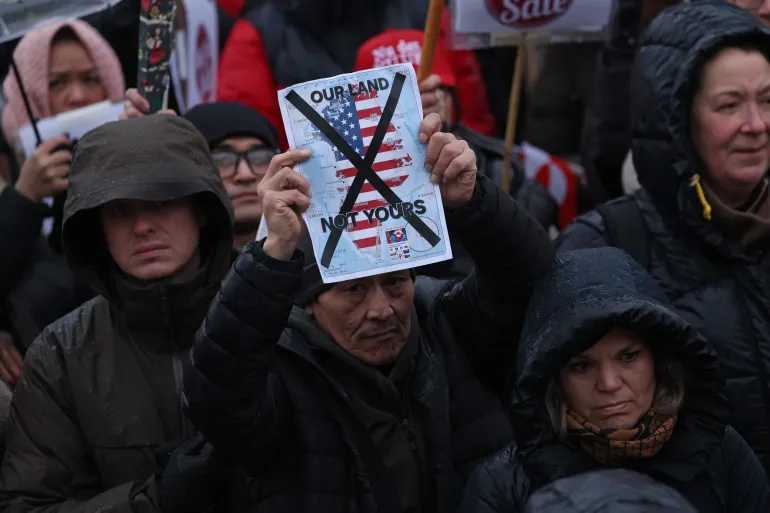
Trump is not the first American president to seek Greenland. In 1946, President Harry Truman secretly offered Denmark $100 million for it. The proposal was rejected and only declassified decades later. However, Trump’s public, aggressive pursuit is unprecedented in the modern era. Public opinion in both the U.S. and Greenland is strongly opposed. A recent Reuters/Ipsos poll showed less than 20% of Americans support acquisition. In Nuuk, protesters have marched with signs reading “Our Land, Not Yours,” illustrating local resistance to becoming a geopolitical bargaining chip.
Potential Implications and Escalation Risks
The Greenland tariff threat introduces severe economic uncertainty. The targeted European nations are major trading partners with the U.S. Sudden tariffs of 25% would disrupt billions in commerce, affecting industries from automotive to agriculture. This coercive use of trade policy for territorial acquisition sets a dangerous international precedent. It blatantly disregards the right to self-determination of Greenland’s 56,000 mostly Inuit inhabitants. The move further strains the transatlantic alliance, already tested by disagreements over Ukraine, China, and now this.
The situation risks a tit-for-tat escalation. If the EU responds with counter-tariffs, a trade war could ensue, damaging both economies. It also complicates NATO cooperation, as the targeted countries are key members. Security and trade are now directly linked in a way that undermines alliance solidarity. The coming days will reveal whether European unity holds and what tools the bloc will use to push back against this Greenland tariff threat. The outcome will signal the limits of Trump’s “America First” diplomacy with even its closest traditional allies.