Washington D.C: Saudi Arabia wants the world to believe that under Vision 2030, it has become the region’s safest, cleanest, and most reliable investment ecosystem. Yet buried beneath headlines about NEOM, futuristic tourism, and trillion-dollar sovereign ambitions is a disturbing truth: the Kingdom’s investment environment is only as strong as its ability to enforce justice. And in some cases, justice is not merely slow, it is absent.
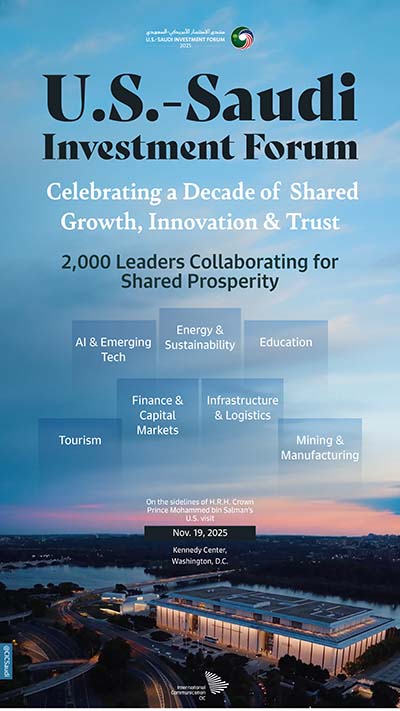
This contradiction becomes even more striking today as Saudi Arabia and the United States gather in Washington to celebrate a decade of expanding economic partnership, another round of glowing statements, new pledges, fresh promises of “unprecedented” investment flows. But as Riyadh speaks in trillions abroad, one foreign investor continues to fight for basic justice at home. The contrast is not just embarrassing; it is alarming.
One investor’s story reveals the uncomfortable gap between reform and reality. It is not a political statement; it is a plea from someone who dedicated twenty years to the Kingdom, contributed to its industrial ambitions, and lost everything despite following every rule. His case should worry anyone watching Saudi Arabia’s economic transformation, because it exposes a structural weakness often ignored in official narratives: when local influence supersedes the law, Vision 2030 becomes vulnerable from within.
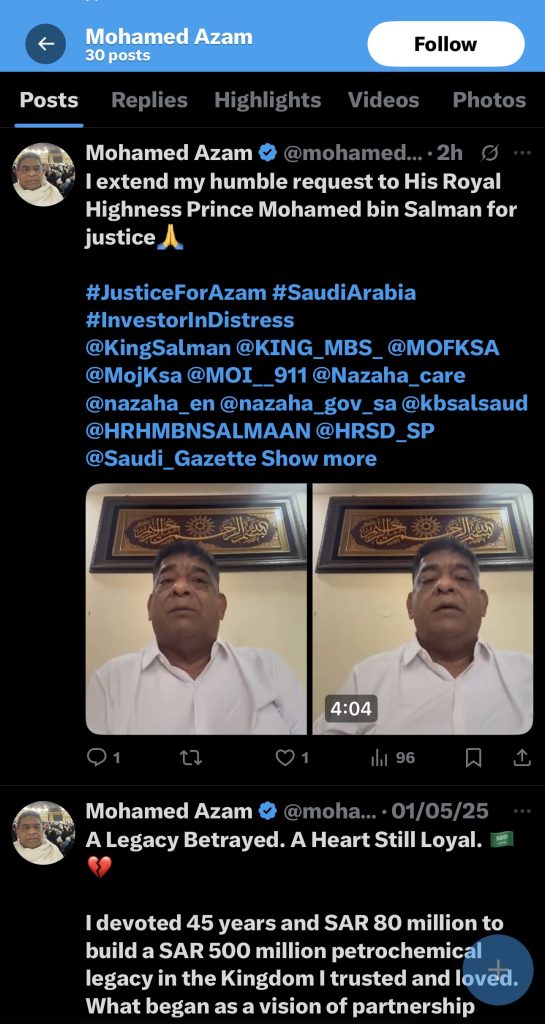
In 2008, when foreign investors were fewer and regulations more opaque, industrial entrepreneur Mohamed Azam arrived in Riyadh with hope and admiration. He believed in the Kingdom’s leadership. He believed in its institutions. He believed in its promise that foreign investors would be protected. With the blessing of the Saudi Investment Authority, he built the Factory of Mohamed Azam for Petrochemicals, a business aligned perfectly with national priorities.
The land for his factory was fully paid for. Construction was nearly complete. Approvals had been issued. And then the ground beneath him collapsed. The seller refused the final transfer and fabricated a lease document to keep ownership. The Riyadh court ruled in Azam’s favor, exposing the fraud. But here lies the crucial problem: the verdict was never executed. A paper judgement that never materializes in real life is not justice; it is bureaucracy masquerading as law.
This judicial paralysis triggered a chain of exploitation that would define the next two decades of his life. During medical treatment abroad, Azam discovered that individuals had forcibly taken over his factory, kidnapped his workers, looted machinery and documents, and continued operations under a new company name. Police reports were filed. Arrests were made. Yet the factory, the core of his investment, was never restored to him. The perpetrators paid a price measured in days of detention; Azam paid a price measured in the ruin of his future.
It gets worse. Proximity to power, real or fabricated, became another tool of deception. Individuals claiming links to “high-ranking figures close to MBS” offered to “settle his files” in exchange for large payments. He paid. They vanished. No official investigation ever reached them.
Parallel land investments in Al Kharj and Jeddah, together worth billions today, remain outside his name despite full payment and, in one case, the backing of three separate courts, including Saudi Arabia’s Final High Court. His own lawyer obstructed the enforcement process. Others misused his power of attorney to drain his remaining funds, freeze his accounts, and sabotage his legal position.
Let us pause here and ask a simple question: If multiple courts in a G20 nation rule in favor of a foreign investor, and yet those rulings cannot be enforced, what does that say about the investment environment?
And more urgently: How can Saudi Arabia promise $1 trillion in U.S. investments when it cannot guarantee the enforcement of a single court order within its own borders?
Vision 2030 promises a new Saudi Arabia that is transparent, efficient, and globally competitive. But visions do not build credibility; systems do. Enforcement does. Accountability does. Without these, every reform remains vulnerable to local networks powerful enough to override national goals.
Azam’s case is not a diplomatic crisis. It is not a rebellion against the Kingdom. It is a warning signal, not only for Saudi Arabia, but for every country that seeks global investment while struggling to reform outdated or inconsistent enforcement structures.
Saudi Arabia cannot afford such contradictions. The kingdom is undergoing its most ambitious economic overhaul in history. It needs foreign capital, foreign expertise, and global trust. If even a handful of investors suffer experiences like this, losing factories, land, legal protection, and dignity, word will spread faster than any promotional campaign can contain. And no number of summits in Washington can conceal that.
And yet, despite everything, Azam’s tone remains profoundly respectful. He speaks not as an enemy of the Kingdom but as someone who still believes in its ideals. He calls Vision 2030 a “moral promise,” not just an economic one. He appeals to the leadership he once admired to intervene so that the spirit of the Vision matches the reality on the ground.
His plea deserves attention, not because he is the only investor facing such circumstances, but because he represents what is at stake for Saudi Arabia’s future. If the Kingdom wants to be the world’s investment magnet, it must confront cases where courts deliver justice but the enforcement chain breaks. It must protect investors not only from crime but also from legal sabotage, procedural inertia, and influence networks that operate beyond accountability.
Saudi Arabia stands at a historic crossroads. It can either let cases like Azam’s undermine the integrity of its transformation, or it can use them to strengthen its institutions and send a message to the world that no injustice will be allowed to stain its economic ambitions.
The choice, ultimately, will determine whether Vision 2030 becomes a global model for reform or a mirage built on promises that were never fully delivered, even as Riyadh courts Washington with trillion-dollar charm offensives.
-Michael Trott