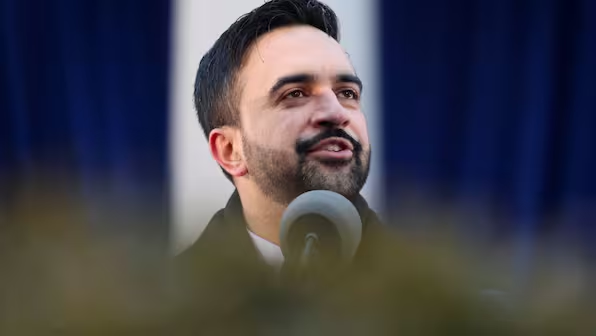
The entry of billionaire activist Tom Steyer into the race to succeed Gavin Newsom as Governor of California threatens to reshape one of the most consequential gubernatorial contests in the United States. Steyer, a longtime climate-and-social-justice donor and former presidential candidate, announced his bid for the 2026 California governor’s race, setting the stage for a high-stakes and high-spend campaign in America’s largest state. His announcement comes as Newsom is term-limited and cannot seek reelection, leaving a wide-open field of contenders across both parties. Steyer’s candidacy brings not only significant personal resources but also a platform focused squarely on affordability, corporate accountability, and climate action—issues resonating with many Californians amid steep living costs and housing shortages.
Steyer frames his entry as a response to what he calls an affordability crisis: “Californians deserve a life they can afford. But the Californians who make this state run are being run over by the cost of living,” he said in his campaign launch. His platform proposes major housing initiatives, utility cost reforms, and closing corporate tax loopholes. The timing of his announcement—amid polling that shows no clear frontrunner and dozens of undecided voters—gives him an opening, though his support levels remain modest in early surveys.
Steyer’s candidacy signals a broader trend: wealthy outsiders leveraging personal fortunes to influence state politics. His background as hedge-fund manager turned activist gives him both resources and critique. While his wealth allows him to self-fund aggressive campaigning, critics question whether he can translate that into grassroots support and electoral legitimacy in a state wary of big-money politics.
In this article, we examine Steyer’s profile, the context of the California governor’s race, his policy platform, the competitive dynamics he faces, and the implications his run might have for the state and national politics.
Steyer’s background and political trajectory
Tom Steyer built his first fortune as founder of a hedge fund, later shifting his focus to activism, climate policy, philanthropy, and political advocacy. He ran for the Democratic nomination for president in 2020, spending large sums of his own money but failing to gain significant traction. In California, he has been active in ballot initiatives and corporate tax reform efforts, such as supporting efforts to close multi-state corporate tax loopholes.
His shift into the gubernatorial contest marks his most direct bid for elected office at the statewide level. At age 68, he brings experience in advocacy though none in elected office. That contrast—wealth and influence versus electoral experience—will shape perceptions of his candidacy.
The California governor’s race context
California’s 2026 gubernatorial contest is wide open. With Governor Newsom barred under term limits, the field on both the Democratic and Republican sides has grown quickly. The top-two primary system in California means that the two candidates with the most votes, regardless of party, will advance to the general election.
On the Democratic side, Steyer joins figures such as former U.S. Representative Katie Porter, former U.S. Secretary of Health and Human Services and former Attorney General of California Xavier Becerra, and former Los Angeles Mayor Antonio Villaraigosa. On the Republican side, candidates like Bullish-voice of state law enforcement Chad Bianco and conservative commentator Steve Hilton are mounting bids.
Polling remains fluid. One survey showed Steyer at only about 1 percent support, with 44 percent of voters undecided, highlighting both the opportunity and the challenge he faces. The cost of campaigning in California—particularly for media across the large Los Angeles and San Francisco markets—means that deep pockets matter, but connection with voters and infrastructure still count.
Steyer’s policy platform and campaign message
Steyer has crafted a platform centered on three major themes: affordability, corporate accountability, and climate/environmental action.
Affordability: Steyer frames his bid around making California more livable for working families. He promises to build a million homes in four years, reduce utility costs, and expand free preschool and community college. He argues that corporations and monopolies have shifted costs to consumers and workers, and that the state should push back.
Corporate accountability: Drawing on his activist past, Steyer has emphasized closing tax loopholes, forcing corporations to pay their fair share, and breaking the power of monopolistic utilities. He references his past success in legislation raising tobacco taxes and closing out-of-state corporate tax lines.
Climate and environment: As a longtime climate activist and founder of organizations such as NextGen America, Steyer continues to emphasize renewable energy, investment in clean economy jobs, and holding polluters accountable. Although his campaign message leans more heavily into affordability this time, the environment remains central.
Strengths and headwinds for Steyer’s campaign
Steyer’s strengths include deep personal wealth, high name recognition among political donors and activists, and an existing network of funding and influence in California politics. His ability to spend heavily on media advertising and to craft a narrative of change could give him an edge in early stages.
However, he faces significant headwinds. First, his lack of prior elected office leaves questions about his executive and governance experience. Voters may ask whether activism and funding translate into governing. Second, his wealth and outsider status open him to critiques that he is attempting to “buy” the office rather than build grassroots support. Critics within his party have already raised those concerns. Third, the crowded field means vote splitting and unknown dynamics. Fourth, early polling is weak, suggesting he must build momentum quickly.
Potential implications for California and beyond
If Steyer becomes competitive or even wins, his campaign could reshape the way California politics handles governance, media spending, and policy priorities. His emphasis on affordability over traditional progressive themes suggests a potential repositioning of the Democratic agenda in California toward economic-justice issues. His campaign might pressure other candidates to respond more vigorously on cost of living and corporate accountability.
Nationally, California remains a bellwether of progressive and Democratic governance. A high-profile race featuring a megadonor candidate may influence how other wealthy activists contemplate statewide office. It could also raise questions about the role of money in politics, campaign finance reform, and how voters respond to outsider wealth in governance.
What to watch next
The key questions in this race will include: whether Steyer can build genuine grassroots support beyond his financial capacity; how he performs in early polls and fundraising relative to rivals; how debates and media narrative frame his outsider status and wealth; how the issues of affordability and housing play out among voters; and how the California electorate responds to the generational and ideological dynamics in the race. With the primary in June 2026 and a general election in November, the next months will be critical in defining whether Tom Steyer’s gubernatorial bid is a bold long-shot or a credible run.