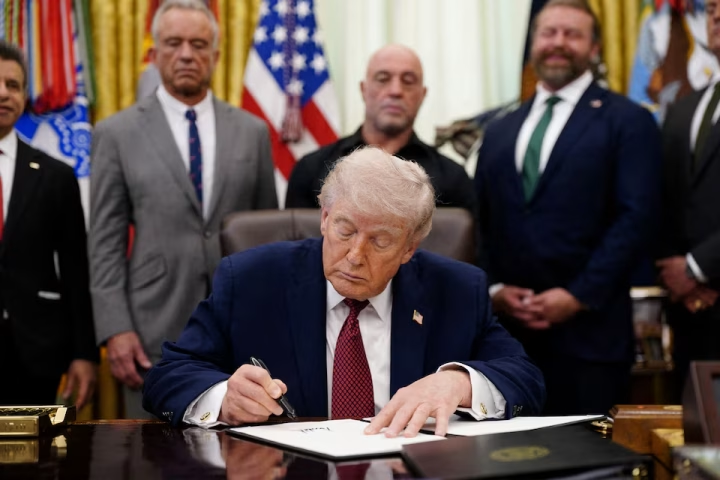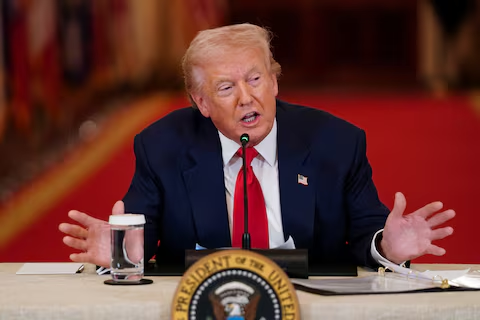
President Donald Trump threatened Sunday to withhold his signature from any other legislation until Congress passes a Republican-backed voting bill. The voter bill Congress push represents the latest escalation in Trump’s effort to impose stricter requirements ahead of November midterm elections. Trump posted on his Truth Social platform that he “will not sign other Bills until this is passed.” He spent the weekend at his Doral, Florida, golf club while making the demand.
The SAVE America Act passed the Republican-led House in February. It would require proof of citizenship when registering to vote. The bill would also impose criminal penalties on election officials who register anyone without required documentation. The voter bill Congress challenge now moves to the Senate, where Republicans hold a slim majority. The measure needs 60 votes to overcome filibuster rules, requiring Democratic support that currently appears unlikely.
Pressure Campaign Intensifies
Trump’s warning comes days after he threatened to bypass Congress entirely through executive order. He previously attempted similar voter eligibility rules via executive action. A federal judge blocked parts of that 2025 order requiring proof of citizenship for registration. The shifting tactics reflect Trump’s effort to pressure lawmakers into adopting his preferred election rules. The voter bill Congress demand represents one approach in a multipronged strategy.
Senate Majority Leader John Thune supports the legislation but has resisted calls to weaken filibuster rules. Thune says insufficient Republican support exists to change the 60-vote threshold. This position creates tension between leadership and Trump’s aggressive timeline. The voter bill Congress push now tests whether Thune can deliver despite procedural obstacles.
Democratic Opposition
Senate Democratic Leader Chuck Schumer said Saturday that Democrats will not support the bill. He called the legislation “Jim Crow 2.0,” referencing historical racial segregation laws that restricted Black voting rights. Schumer argued the measure would “disenfranchise tens of millions of people.” If Trump refuses to sign other legislation, Schumer warned, “There will be total gridlock in the Senate.”
Democratic leaders view the voter bill Congress effort as an attempt to suppress turnout and undermine their electoral chances. Independent analysts currently favor Democrats to take control of the House. Trump’s last two years in office could face complications if Democrats control either chamber. The voting rights battle thus carries high stakes for both parties.
Enforcement Questions
Whether Trump would follow through on his vow to block other legislation remains unclear. If lawmakers pass a bill and he takes no action for ten days while Congress is in session, the measure becomes law without his signature. This constitutional provision could limit his ability to enforce the threat. The voter bill Congress demand may function more as political pressure than actual veto strategy.
Republicans have been jarred by a string of Democratic special election wins. These outcomes suggest potential voter enthusiasm favoring Democrats heading into November. The voter bill Congress push aims to address perceived vulnerabilities in election integrity. Critics argue it responds to political losses rather than genuine reform needs.
Procedural Hurdles
The Senate filibuster presents the most immediate obstacle. Sixty votes remain necessary for most legislation to advance. Republican holds only 53 seats, requiring at least seven Democratic supporters. None have emerged publicly. The voter bill Congress effort thus faces mathematical impossibility without bipartisan cooperation.
Thune’s resistance to changing filibuster rules reflects institutionalist Republican views. Some conservatives advocate the “nuclear option” to eliminate the 60-vote threshold for this legislation. Thune maintains insufficient conference support for such a move. This internal Republican debate could determine whether the voter bill Congress push succeeds or fails.
Midterm Implications
Trump’s aggressive posture reflects awareness that November outcomes will shape his final two years. Democratic control of either chamber would enable investigations, block appointments, and limit legislative achievements. The voter bill Congress fight thus connects directly to broader political strategy. Success would deliver a signature accomplishment while potentially influencing turnout dynamics.
Republicans argue that voter ID requirements enjoy broad public support across partisan lines. They frame the SAVE Act as common-sense integrity measures. Democrats counter that existing laws already address fraud, which occurs at infinitesimal rates. They point to blocked voters as the real risk. The voter bill Congress debate encapsulates deeper disagreements about American democracy itself.
Looking Ahead
Trump’s weekend posting sets up a critical test for congressional Republicans. They must either deliver the voting bill or explain failure to their base. Neither option appears straightforward given current math. The voter bill Congress demand may ultimately force a choice between confronting filibuster rules or accepting defeat.
Schumer’s gridlock warning suggests Democrats will force the issue if possible. They may bring other legislation forward specifically to test Trump’s veto threat. Government funding bills, defense authorizations, and must-pass measures could become bargaining chips. The voter bill Congress standoff thus threatens broader governing functionality.
For now, the situation remains in flux. Trump issued his demand. Democrats stated opposition. Republicans expressed support without clear path to passage. The coming weeks will reveal whether the voter bill Congress push achieves its goal or joins previous failed efforts to reshape election rules through legislative action.