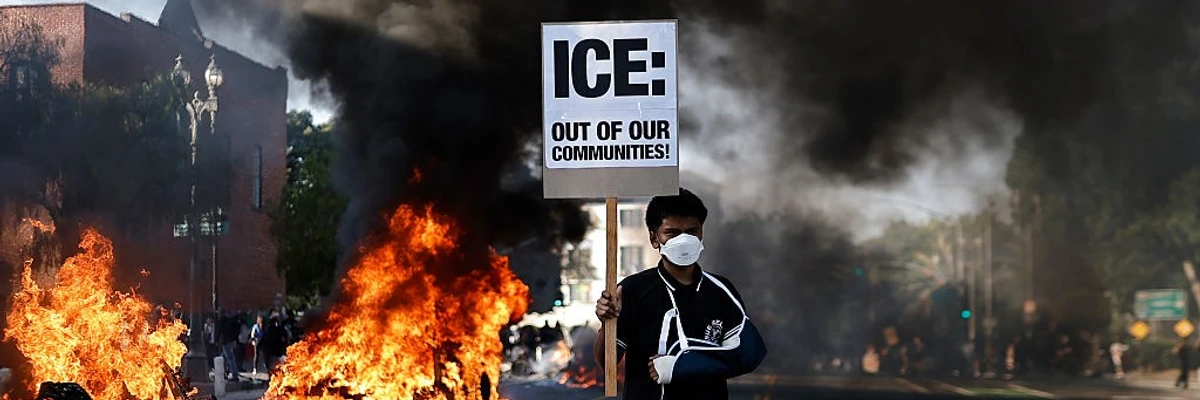
At the heart of the LA immigration raids resistance stands a network of community defenders who rise before dawn, trained not in warfare but in vigilance. On a foggy summer morning, they gathered near Terminal Island, a strategic outpost where federal immigration agents begin their day. Among them was Chavo Romero, coffee in hand, watching for the first white SUVs to roll through a checkpoint into the federal compound.
Unión del Barrio: Grassroots Eyes on ICE
Founded more than 30 years ago, Unión del Barrio is at the forefront of LA immigration raids resistance. The volunteer-led coalition patrols Los Angeles neighborhoods to monitor and report Immigration and Customs Enforcement (ICE) activity. Armed with cameras and cell phones, they livestream enforcement movements to alert vulnerable communities.
Romero and others document the make, model, and license plate of ICE and CBP vehicles as they leave Terminal Island. “They’re clocking in to go kidnap people,” Romero said. “They see us, they flip us off.”
These actions are rooted in history. The group began patrolling LA neighborhoods after the 1992 Rodney King riots, and their work has intensified amid rising immigration crackdowns under the Trump administration. Since June, patrols have increased exponentially in response to militarized raids that target communities based on race and occupation.
Raids and Racial Profiling Spark Outrage
The raids have swept across southern California, from Home Depot parking lots to cannabis farms. In one disturbing incident, over 200 people were arrested during a raid in Ventura County, and one man died. According to a lawsuit by the ACLU, agents operated without warrants, using skin color and job roles as the only criteria for arrest.
Immigration attorney Keli Reynolds, who has practiced under five U.S. presidents, called the current conditions “unprecedented.” “They were detaining people, tackling them, and there was absolutely no reasonable suspicion,” she said. “Almost 100% of those detained were Latinos.”
A temporary federal restraining order issued on 11 July now prohibits arrests based on race or occupation in the central district of California. While it slowed some activity, ICE adapted. Now, agents are reportedly claiming to have warrants while detaining people outside their homes—without showing any documentation.
From Surveillance to Solidarity
The resistance extends far beyond watching ICE. Unión del Barrio’s volunteers have trained over 750 people since the court order, working under the larger umbrella of the Community Self-Defense Coalition. Their mission: teach residents how to document ICE raids, demand warrants, and protect their communities through legal and peaceful means.
Ron Gochez, the group’s LA chapter founder, said, “The goal is to see nothing, but if we see something, we inform the community.” Despite threats and surveillance—like LAPD helicopters circling their patrols—the group continues.
“This is a ceasefire,” Gochez said. “And during a ceasefire, you regroup, because you know it’s going to start again.”
Federal Pushback and Political Pressure
In June, the Trump administration went on the offensive. Senator Josh Hawley accused Unión del Barrio of “aiding and abetting criminal conduct,” referencing their role in resisting what many see as unconstitutional raids. The group dismissed the allegations, stating they are defending communities from “militarized immigration operations.”
Romero was blunt: “They were asking us to voluntarily cease and desist. We said: ‘We’re going to voluntarily tell you no.’”
The political spotlight has not deterred them. They argue that the billion-dollar deportation industry won’t stop unless communities keep fighting back.
Los Angeles as a Frontline
Los Angeles is more than just a city—it’s a symbolic and strategic frontline in the battle over immigration policy. As Romero put it, “If they’re able to crush the LA resistance, they’ll do it everywhere else.”
Latino communities have rallied in solidarity, cautiously reoccupying public spaces like sidewalks and markets, but always with an eye on social media and alert networks.
“We’re not backing down,” Romero affirmed. “They thought they’d scare everyone into silence. But this is LA—and LA is resisting.”