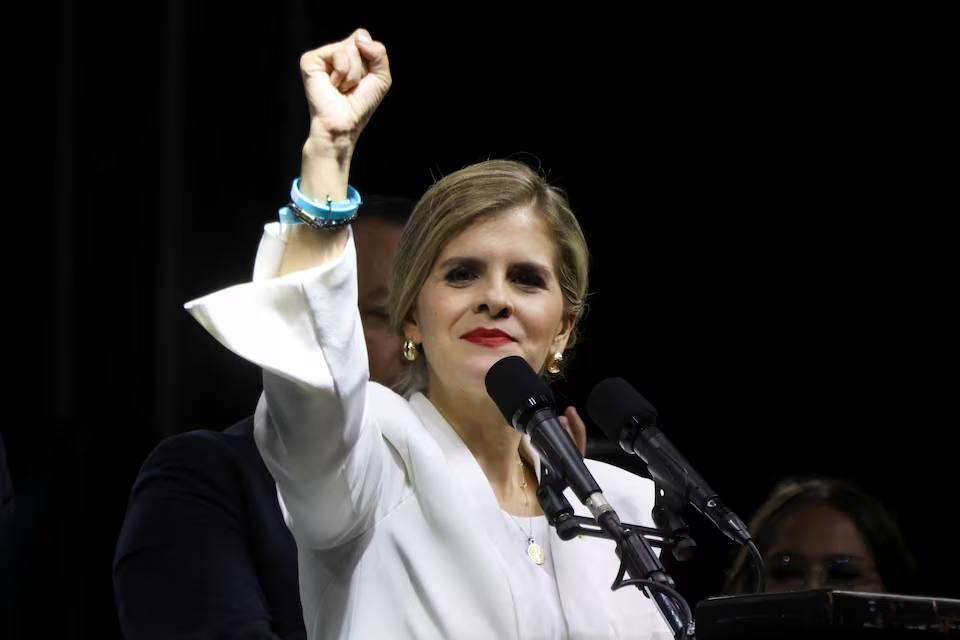
Laura Fernandez has won Costa Rica’s presidential election, pledging to continue the populist path set by her predecessor and political mentor, Rodrigo Chaves. The 39-year-old former Minister of Planning will become the nation’s second female president. Fernandez campaigned on a platform of constitutional reform and a hardline security approach inspired by El Salvador’s Nayib Bukele. Consequently, her victory signals a deepening of the political transformation begun under Chaves, moving Costa Rica away from its traditional stable democracy.
Fernandez served as Chaves’s chief of staff after his appointment of her as a minister. A key lawmaker revealed that Chaves and a small circle hand-picked Fernandez as his successor. This direct lineage ensures policy continuity. Fernandez has promised “deep and irreversible” change, declaring the end of Costa Rica’s “second republic” that began in 1948. She now aims to build a “third republic,” a slogan indicating profound institutional shifts. Her win consolidates the populist movement’s hold on power.
A Security-First Platform and Bukele Influence
A central pillar of Fernandez’s platform is combating drug-related violence, which has surged in Costa Rica. She openly admires Salvadoran President Nayib Bukele’s hardline tactics. Fernandez pledges to enact states of emergency in high-crime areas, which would suspend certain civil liberties. She also vows to complete a high-security mega-prison modeled on El Salvador’s CECOT facility. This repressive approach marks a dramatic shift for a nation historically known for its peaceful democracy and lack of a standing army.
Fernandez’s conservative Catholic and pro-family messaging helped her garner support from growing evangelical groups. Her theatrical campaign style, including public dancing, contrasted with her serious policy proposals. The focus on crime resonates with a population increasingly fearful of gang violence and trafficking. However, critics warn her plans risk eroding human rights and democratic norms. Former President Laura Chinchilla, the country’s first female leader, has labeled Fernandez “rude and populist” and a “bad copy” of Chaves.
Continuity of the Chaves Political Project
Fernandez’s victory is widely seen as a referendum on Rodrigo Chaves’s first term. The outgoing president remains highly popular among his base despite controversies. Lawmaker Pilar Cisneros, a key Chaves ally, stated Fernandez would be foolish not to show his backing. She emphasized Fernandez’s loyalty to their political project. This connection suggests Chaves will retain significant influence behind the scenes. Critics who called Fernandez a “puppet” during the campaign foresee a government still directed by the former president.
Fernandez’s background as a civil servant and planning minister is a key asset. Cisneros noted, “Few people know the state like she does — she knows where the knots are.” This administrative experience may help her navigate the bureaucracy to implement her agenda. Her mandate is to extend Chaves’s populist reforms, which include battling established political elites and restructuring state institutions. The goal is to entrench their movement’s power for the long term, fundamentally altering Costa Rica’s political landscape.
Read Also
Australia Enacts Social Media Ban for Under-16s
France Moves to Ban Social Media for Under-15s
Domestic and International Reactions
The international community will watch Fernandez’s presidency closely. Costa Rica has long been a bastion of stability and environmental stewardship in Central America. A turn toward Bukele-style authoritarian populism may strain relations with traditional partners like the United States and the European Union. However, it may align Costa Rica more closely with other regional governments adopting strongman tactics. Foreign investment could be affected by perceptions of democratic backsliding and potential institutional instability.
Domestically, the opposition is weakened but vocal. Former President Laura Chinchilla has become a leading critic, accusing the movement of following a “predictable script” of regional authoritarianism. She and other centrist and leftist figures will likely challenge Fernandez’s more radical reforms, especially any constitutional changes. The strength of Costa Rica’s independent institutions, including its courts and electoral tribunal, will be tested as Fernandez pushes her agenda through a potentially compliant legislature.
Challenges Ahead: Economy and Institutional Reform
Beyond security, Fernandez inherits significant economic challenges. High living costs, unemployment, and fiscal deficits persist. Her background in economic planning will be critical. However, her populist rhetoric often clashes with technocratic solutions. She must balance delivering tangible economic improvements to her base while maintaining investor confidence. Any constitutional reform process will be lengthy and divisive, potentially consuming political capital and distracting from governance.
The promise to build a “third republic” is ambitious and vague. It could encompass everything from rewriting the constitution to overhauling the civil service. Such sweeping changes risk creating prolonged uncertainty. Fernandez’s ability to translate populist energy into effective, legal governance will determine her success. Her administration will also need to manage relations with a powerful executive branch predecessor in Chaves, who may not easily relinquish influence.
A New Era for Costa Rican Democracy
Laura Fernandez’s election marks a definitive turning point. The victory of a Chaves protégé confirms a lasting shift in the electorate’s preferences. Voters have chosen a promise of security and radical change over Costa Rica’s traditional model of consensus and gradual reform. The coming years will reveal whether this populist path leads to greater safety and prosperity or to democratic erosion and social division. The world now observes whether Costa Rica’s famed democracy can withstand the pressures of a new, more confrontational political era.