California Governor Gavin Newsom’s office announced a $2.9 billion budget deficit for the coming fiscal year. This marks the fourth consecutive year of multibillion-dollar shortfalls for the state. While significantly lower than earlier projections, the gap still forces tough choices. Consequently, Newsom will have little room to launch major new initiatives during his final year in office.
The Deficit Context and Political Battle
The governor’s $349 billion budget proposal now enters a months-long negotiation with the state legislature. Newsom’s deficit estimate is far below the nonpartisan Legislative Analyst’s $18 billion projection from November. His administration credits higher-than-expected revenues for narrowing the gap. However, State Controller Malia Cohen warns the state is already overspending by nearly $6 billion halfway through the fiscal year, urging a “disciplined approach.”
Republican Criticism and Democratic Control
Republican lawmakers, who hold little power due to Democratic supermajorities, criticized the recurring deficits. State Senator Tony Strickland argued, “California families have to balance their budgets… The state government should be held to the same standards.” The process will be dominated by Democratic priorities and internal debates over cuts, reminiscent of last year’s rollback of free healthcare for some immigrants.
Key Proposals: Education, Housing, and Reserves
Despite constraints, Newsom’s budget outlines significant spending in core areas.
Education Investments
Newsom promises “the most significant investments” in public education. His plan includes fully funding universal transitional kindergarten, spending over $27,000 per student, and allocating $1 billion to high-need schools. He also proposes moving the Department of Education into the executive branch—a shift that may require voter approval.
Housing, Homelessness, and Reserves
On housing, Newsom signaled support for legislation to restrict large investors from buying affordable homes. However, he proposes no new homelessness funding for local governments, following a $500 million allocation last year. To restore fiscal health, Newsom wants to rebuild state reserves. This includes depositing billions into the rainy day fund, a special emergency fund, and school reserves, while using $3 billion to pay down state debt.
Climate and Legal Priorities
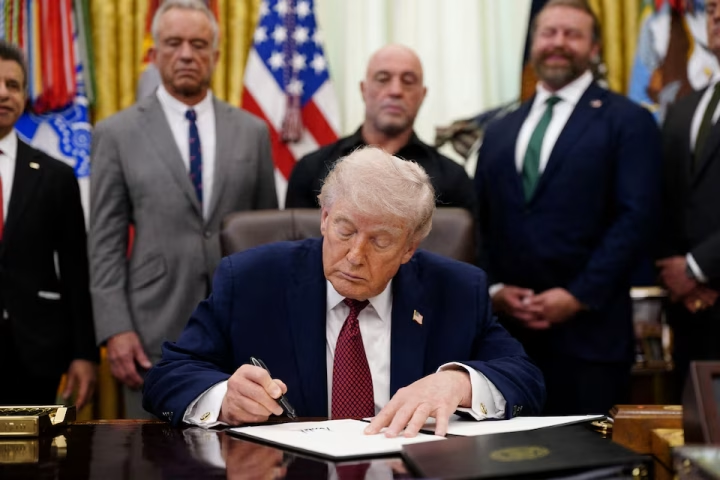
The budget also reflects political battles with the federal government. It includes $200 million for an electric vehicle rebate program, aiming to backfill federal incentives cut under the Trump administration. Furthermore, Newsom proposes more funding for the state Department of Justice to continue lawsuits against the Trump administration. California has filed over 50 such lawsuits since last year.
A Constrained Final Chapter
The $2.9 billion deficit sets a constrained tone for Newsom’s final year. While lower than feared, it necessitates fiscal caution and limits ambitious new spending. The coming negotiations will test the Democratic supermajority’s ability to balance education promises, housing needs, and reserve rebuilding. Ultimately, this budget cycle is less about legacy programs and more about ensuring long-term fiscal sustainability for the nation’s most populous state.