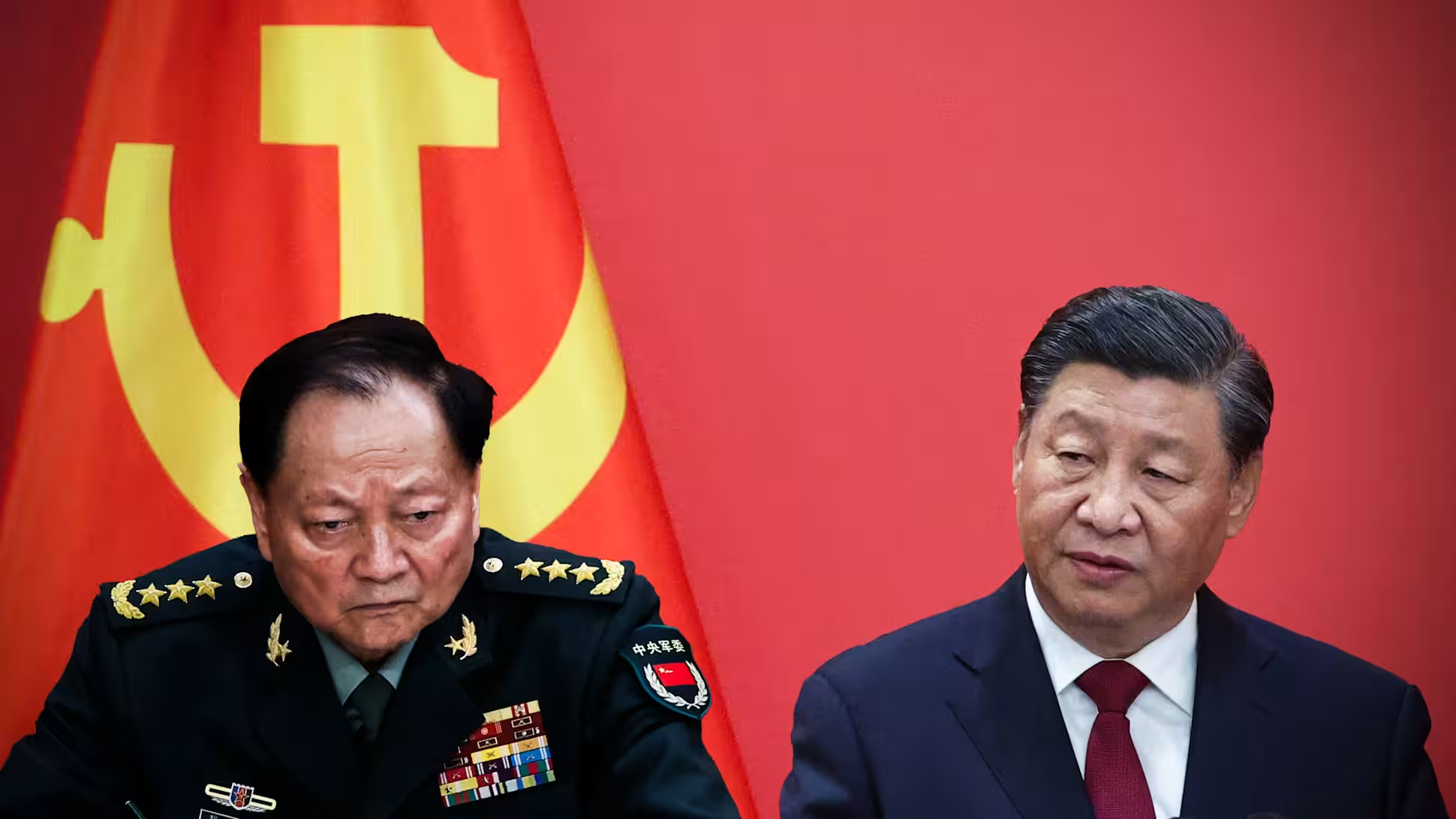
news broke that Zhang Youxia, a key figure in China’s military hierarchy, and his colleague, Liu Zhenli, were being investigated by China’s Ministry of National Defense for “serious violations of discipline and law”. This move has ignited intense speculation about a power struggle between Xi Jinping, the paramount leader of the Chinese Communist Party (CCP), and Zhang Youxia, his former ally and the second-highest-ranking military official in China. This investigation marks a dramatic turning point in the internal politics of the CCP, underscoring the centrality of the military in the party’s leadership dynamics.
While some view this as a victory for Xi, others argue that no one truly emerges as a winner in this political infighting, as it further destabilizes the Party’s already volatile internal structure. The Xi-Zhang power struggle sheds light on the broader political forces shaping China’s future, with implications for both the military and the CCP’s governance.
The Anti-Corruption Campaign: A Veiled Power Struggle
In the official narrative, the investigation into Zhang Youxia and Liu Zhenli is framed as part of Xi’s anti-corruption campaign, which has been a central theme of his rule since he took office in 2012. The CCP’s official media outlets, such as the PLA Daily, have hailed the probe as a major achievement in the battle against corruption. However, critics contend that Xi’s so-called anti-corruption campaign has always been a political tool—a way to purge his rivals and consolidate power, particularly within the military. Xi’s political purges, under the guise of fighting corruption, have removed key figures from the People’s Liberation Army (PLA), and the ongoing investigation into Zhang’s activities is no exception.
The military has always held immense power in China, and Xi’s efforts to control it have been central to his tenure. The well-known Maoist saying, “Political power grows out of the barrel of a gun,” has guided the CCP’s actions for decades. Whoever controls the military essentially controls China. Xi’s drive to dominate the military is rooted in his desire to protect his authority and ensure the stability of his regime.
However, Xi’s own actions reveal that his supposed anti-corruption drive may be more about securing his personal hold on power than addressing genuine systemic corruption. Historically, the Chinese leadership has used anti-corruption campaigns to eliminate rivals. The purge of Xu Caihou and Guo Boxiong, former vice chairmen of the Central Military Commission (CMC) in 2014 and 2015, was a key example of Xi’s broader strategy to weaken the influence of his predecessor’s supporters in the military and ensure loyalty to his leadership.
The Xi-Zhang Power Struggle: A Tactical Battle for the Military
Xi’s move against Zhang Youxia is seen by many as the latest chapter in a long-running power struggle. After the 20th Party Congress in 2022, where Xi secured an unprecedented third term, he gained full control of the CMC—the body responsible for overseeing China’s military. Zhang Youxia was appointed as one of the vice chairmen of the CMC, but Xi’s subsequent purges within the military suggest that Zhang’s position was more precarious than it appeared.
By mid-2024, rumors began to circulate that Xi had suffered a sudden illness, which led Zhang to ally with a range of dissatisfied Party elders, military figures, and princelings (the descendants of former revolutionary leaders). Zhang’s political maneuvering gained momentum after he successfully removed several of Xi’s key military allies, including Miao Hua and He Weidong, both of whom were high-ranking members of the CMC. These actions left Zhang with effective control over the military for a period, and Xi found himself on the defensive.
Xi, unwilling to cede control, waited for the right moment to strike. When the opportunity arose, Xi moved decisively. Using Wang Xiaohong, his trusted protégé and Minister of Public Security, Xi launched an attack on Zhang and Liu Zhenli, ensuring their swift downfall. By making the announcement of their downfall public and official, Xi solidified his victory before Zhang could mount a significant counteroffensive.
The Current Landscape: Xi’s Victory or a Pyrrhic Win?
While Xi has emerged victorious in this round of the struggle, the overall impact of the Xi-Zhang conflict is more complex. In the wake of Zhang’s removal, Xi now faces an isolated military leadership structure. The purges and infighting have left him with few loyal allies, and it remains unclear who, if anyone, will back him when the next power struggle inevitably arises.
With the purging of Zhang Youxia and his supporters, Xi now controls the military, but at a significant cost. His anti-corruption campaign has turned nearly 300 generals into political adversaries, creating powerful networks of opposition within the PLA. These factions, many of whom have aligned themselves with Zhang or other former leaders, represent a severe threat to Xi’s continued rule. The CCP’s internal landscape is now one of constant, life-or-death battles for power, where alliances are fleeting and loyalty is often fleeting.
Historical Context: Power Struggles in CCP History
The Xi-Zhang conflict is not an anomaly but rather a continuation of the CCP’s history of infighting. From its inception, the Party has been marked by violent purges and internal struggles. Mao Zedong, who led the CCP for decades, famously used violent campaigns like the Yan’an Rectification movement to eliminate rivals and secure his own power. During his tenure, countless purges wiped out prominent figures in the Party, including Liu Shaoqi, Peng Dehuai, and Lin Biao, all of whom had been considered possible successors to Mao.
In the years following Mao’s death, the CCP continued to be plagued by infighting. Deng Xiaoping rose to power by eliminating rivals from the Cultural Revolution and securing control over China’s political system. Similarly, Jiang Zemin used his position to purge military figures like the Yang brothers to maintain dominance. In the present day, Xi’s own purge of military officials represents a modern-day version of this historical pattern.
The Future: Will Xi’s Rule Continue Unchallenged?
As Xi consolidates control, one of the key questions is whether his leadership can withstand future challenges. The military, the Party’s most powerful institution, remains the linchpin of his rule. Despite his recent triumph, Xi’s reliance on purges and political purges to maintain control over the military has alienated almost every major faction within the CCP, from the first-generation Party elders to the second-generation princelings and even the Communist Youth League faction.
Xi’s paranoia and his tendency to purge those closest to him leave him vulnerable to political challenges. The question now is whether Xi can continue to hold onto his power while keeping the military’s loyalty intact, especially with so many adversaries left in the ranks.
A Future of Constant Struggle
The ongoing power struggle between Xi Jinping and Zhang Youxia represents the unsustainable nature of the CCP’s internal politics. For Xi Jinping, the path forward may seem clear, but the constant need to defend his power may ultimately lead to his isolation. The next phase of Chinese political life is bound to see more infighting, with the fate of the CCP’s leadership remaining in the balance.
The Xi-Zhang conflict is a reminder that, as long as China’s leaders remain committed to a political culture of struggle and purges, the Chinese Communist Party’s internal battles will continue to shape the country’s future. Until a fundamental shift in governance occurs, no leader will ever feel secure, and power struggles will remain a central feature of China’s political life.