California Governor Gavin Newsom has found himself at the center of controversy after being blocked from speaking at a prominent event during the 2026 World Economic Forum (WEF) in Davos, Switzerland. The Democratic governor, who oversees one of the world’s largest economies, accused the Trump administration of interfering in his participation and preventing him from engaging with the international audience at the event.
The incident unfolded when Newsom was invited to speak at a Fortune-hosted event at the USA House—the official U.S. pavilion at the global summit. His office shared the news on X (formerly Twitter), expressing frustration at being denied access despite the earlier invitation. Newsom’s public statement highlighted the perceived irony of being barred from representing California, stating: “California was just denied at the USA House. Last we checked, California is part of the USA.”
The snub from the U.S. pavilion caught many by surprise, as the governor was initially scheduled to engage in a fireside chat at the event, which aimed to bring together policymakers and business leaders for discussions on various global issues.
White House Criticism and the Denial
Newsom’s participation in Davos 2026 came under scrutiny from the White House, where spokeswoman Anna Kelly publicly criticized the governor’s attendance. Kelly suggested that Newsom should be focusing on local issues in California, such as the state’s homelessness crisis, wildfires, and its budget challenges, rather than attending an international forum. In a statement sent to the BBC, Kelly stated: “No one in Davos knows who third-rate governor Newsom is or why he is frolicking around Switzerland instead of fixing the many problems he created in California.”
While Kelly did not directly address whether the White House played a role in blocking Newsom from speaking, Newsom’s office firmly claimed that the decision to cancel his appearance was under direct pressure from the White House and the State Department. The governor’s office also pointed to the role of the USA House in preventing his speech.
A Shift in Programming or Political Maneuvering?
According to Newsom’s office, an official from USA House informed them just before the event was set to begin that the Fortune event would be canceled, and Newsom would not be allowed to engage with the media at the pavilion. The reason provided was that the appearance of another elected official did not “align with the afternoon programming,” a justification that Newsom’s office found inadequate and politically motivated.
Instead of being given the opportunity to speak at the scheduled event, USA House suggested Newsom could attend a “nightcap reception,” an alternative that the governor’s team found to be a less-than-adequate replacement for the original speaking engagement.
Newsom Responds to the Treatment at Davos
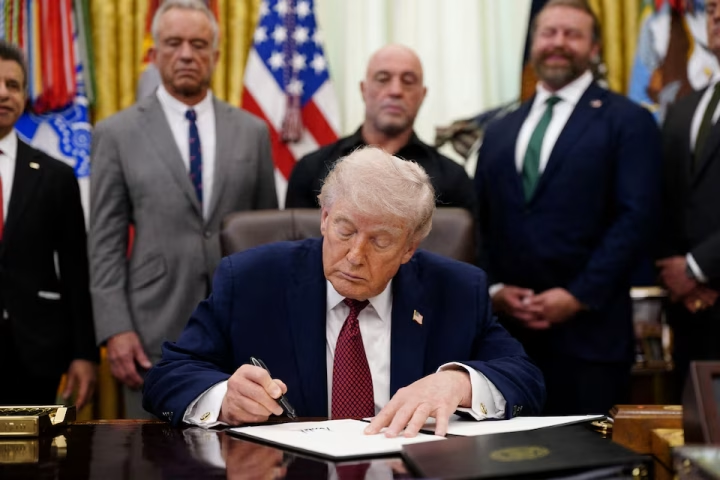
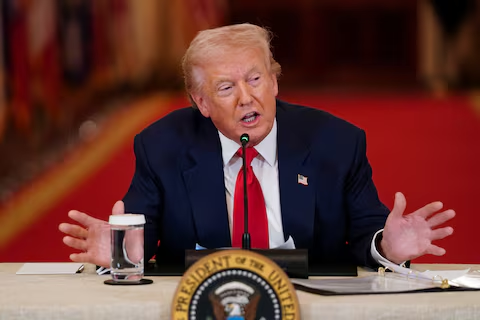
In the wake of the cancellation, Newsom was seen among the audience when former President Donald Trump delivered a speech to world leaders at the WEF. Trump, who had a contentious relationship with Newsom as governor, made a pointed remark about the governor during his address. In his speech, Trump took a jab at Newsom’s absence from a proposed collaboration, saying, “I would say this, if I were a Democrat governor, or whatever, I would call up Trump, I’d say, ‘Come on in. Make us look good.’”
As Trump’s speech continued, a camera captured Newsom laughing at moments of the former president’s rhetoric. However, Newsom later downplayed the significance of the speech, calling it “boorish” and “remarkable in its inconsequential nature.” He said he expected more substantive discussions from Trump but found the address to be largely uninspiring.
The Political Dynamics Behind the Block
The exclusion of Newsom from speaking at the Davos event is seen as part of the political and ideological divide that has characterized Newsom’s relationship with Trump’s administration. While Newsom has often criticized Trump’s policies, particularly in areas like climate change, healthcare, and social welfare, the relationship between the two has remained publicly tense. Newsom has frequently voiced his opposition to Trump’s leadership and has been mentioned as a potential Democratic contender for the 2028 U.S. presidential election.
Despite the political friction, Newsom remained unfazed by the political theatrics at Davos. His office expressed disappointment with the way the situation unfolded, noting that such blockages of public discourse at international forums only serve to undermine democratic values. In his comments, Newsom said, “How weak and pathetic do you have to be to be this scared of a fireside chat?” He further emphasized the growing political friction as a strategic tactic to discredit his leadership and influence.
The Broader Context: California’s Global Role and the Davos Platform
The incident underscores the increasing politicization of global platforms like Davos, where business leaders, policymakers, and activists converge to discuss pressing international issues. The World Economic Forum, with its prominent international audience, has historically been a stage for national leaders and influencers to engage in dialogues on economic development, global security, and environmental sustainability. Newsom’s exclusion from the event raises questions about the role of U.S. leadership in shaping international discourse and whether partisan politics is now dictating who gets to speak at such forums.
California’s role as an economic powerhouse cannot be overstated. As the fifth-largest economy in the world, California plays a central role in global trade, technology, climate policy, and innovation. Newsom’s leadership has been instrumental in pushing forward climate change policies, healthcare reforms, and technological advancements, making the governor an important figure on the world stage.
The blocking of Newsom’s speech at Davos also highlights the broader tensions between state and federal authority in the U.S. While the federal administration may seek to stifle the governor’s influence on the global stage, California remains a leading force in the climate action and technology sectors—sectors that have global implications.
What’s Next for Gavin Newsom?
Looking ahead, Gavin Newsom is expected to remain a prominent figure in U.S. politics. As he weighs a potential presidential run in 2028, the decision to block his participation at Davos could bolster his image as a leader willing to challenge federal authority. His actions at the World Economic Forum and his vocal response to the treatment he received may only fuel his ambition to position himself as a strong alternative to the policies of the Trump administration.
For now, the attention around this episode continues to grow as it sparks questions about the nature of political power, global forums, and the fight for influence in an increasingly polarized world.