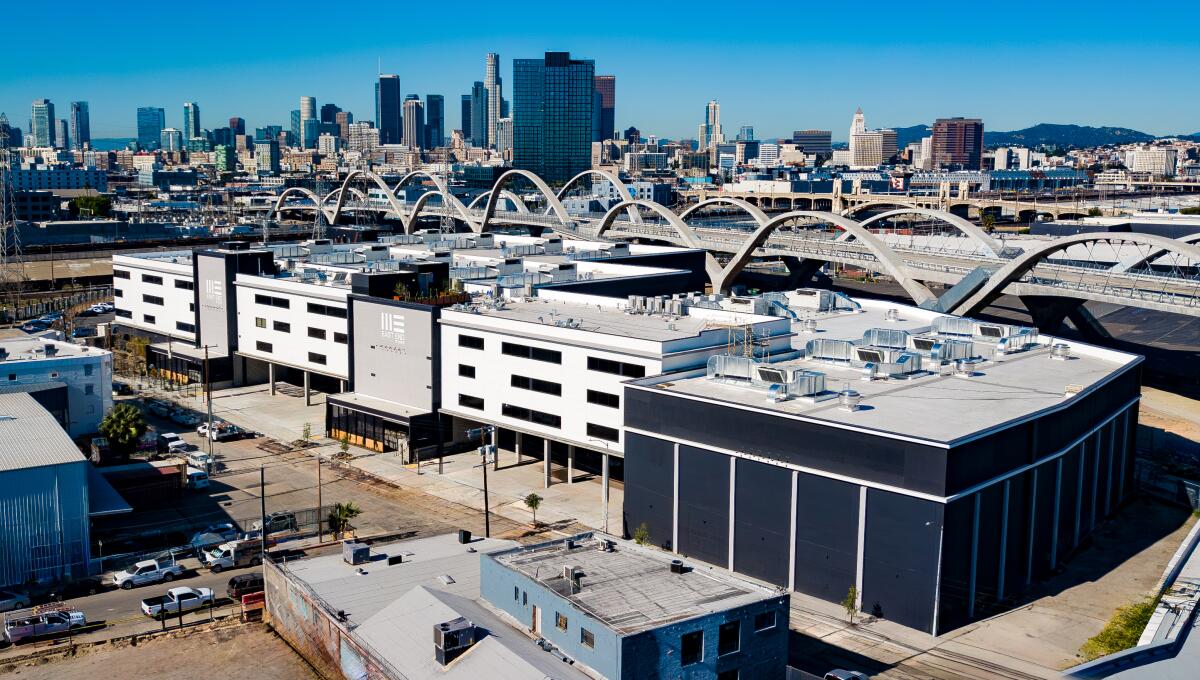
Los Angeles is facing a quiet crisis in its entertainment heartland: soundstages are sitting empty. Even with the recent opening of the $230 million East End Studios – Mission Campus in Boyle Heights—and fresh state tax incentives—no production has yet signed on to use its five soundstages and offices. “Everyone is doing their best to try to bring productions back to Los Angeles,” said industry veteran Wainright, “but it’s pretty dire.”
This emptiness reflects a broader collapse in LA soundstage occupancy. According to FilmLA, the nonprofit that tracks local filming, average annual occupancy dropped to just 63% in 2024—down from 69% in 2023 and far below the 90% average seen during the peak TV years of 2016 to 2022. Moreover, early data for 2025 suggests little improvement, with shoot days falling another 16% last year.
The downturn has hit even major players hard. For instance, Hackman Capital Partners, one of Hollywood’s largest studio landlords, recently defaulted on its $1.1 billion mortgage for the historic Radford Studio Center in Studio City. After buying the lot for $1.85 billion in 2021—at the height of “peak TV”—the company now faces foreclosure, with lender Goldman Sachs poised to take control. Unfortunately, the timing was disastrous: the purchase came just before pandemic slowdowns, the 2023 dual strikes, and deep cuts in studio spending.
Real estate broker Carl Muhlstein calls this a warning sign. “We’re going to have fewer studios,” he said. “Unfortunately, this could be the first of several foreclosures.” Indeed, many newer studios, built during the streaming boom, now struggle with high debt and low demand. Furthermore, some face even steeper refinancing costs than Radford—and less filming business to offset them.
So what went wrong? For years, streaming giants like Netflix and legacy studios like Disney poured billions into original content, racing to capture viewers. By 2022, nearly 200 scripted shows were in production. In response, landlords built or bought soundstages at record pace. However, the model wasn’t sustainable. As streaming growth slowed, studios slashed budgets, shortened episode orders, and shifted production overseas—where costs and taxes are lower.
“Los Angeles has the best infrastructure, the best crews, and the deepest creative talent,” said Hackman CEO Michael Hackman. “But California has failed to keep the industry competitive with tax credits offered by other states and countries.” He blamed years of “policy neglect,” compounded by strikes and market shifts, for the exodus of jobs and tax revenue.
In response, California revamped its film and TV tax credit program in 2025. Specifically, lawmakers boosted funding and expanded eligibility to include competition shows and shorter-format series. Officials hope this will lift LA soundstage occupancy—though likely not back to the 90% highs. “Our hope is that we can reach a sustainable place,” said FilmLA spokesman Philip Sokoloski, “with space for anyone who needs it and work for local crews.”
Still, structural challenges remain. For example, streaming’s shift to shorter seasons doesn’t support long-term stage rentals like old network TV did. At the same time, global competition is fierce. “You can go to London, you can go to Hungary, you can go to Vancouver,” Muhlstein noted.
Even small historic studios feel the strain. Occidental Studios—once home to Mary Pickford and Cecil B. DeMille—is for sale at $45 million. Owner Craig Darian says business has slowed but adds, “We’re not eager to sell. We’re looking for the correct exit.”
Meanwhile, corporate giants like Warner Bros., NBCUniversal, and Fox may gain ground. Notably, Fox is moving ahead with a $1.5 billion expansion on its Century City lot, where “Baywatch” is rebooting and Fox Sports produces major NFL programming.
Wainright sees glimmers of hope. “I would like to think that 2024 and 2025 are kind of the bottom,” he said, “and that we’re going to be pulling ourselves up.” With new incentives in place, the key question is whether LA can rebuild—not just stages, but a truly sustainable production ecosystem. Until then, the silence on many soundstages speaks volumes.